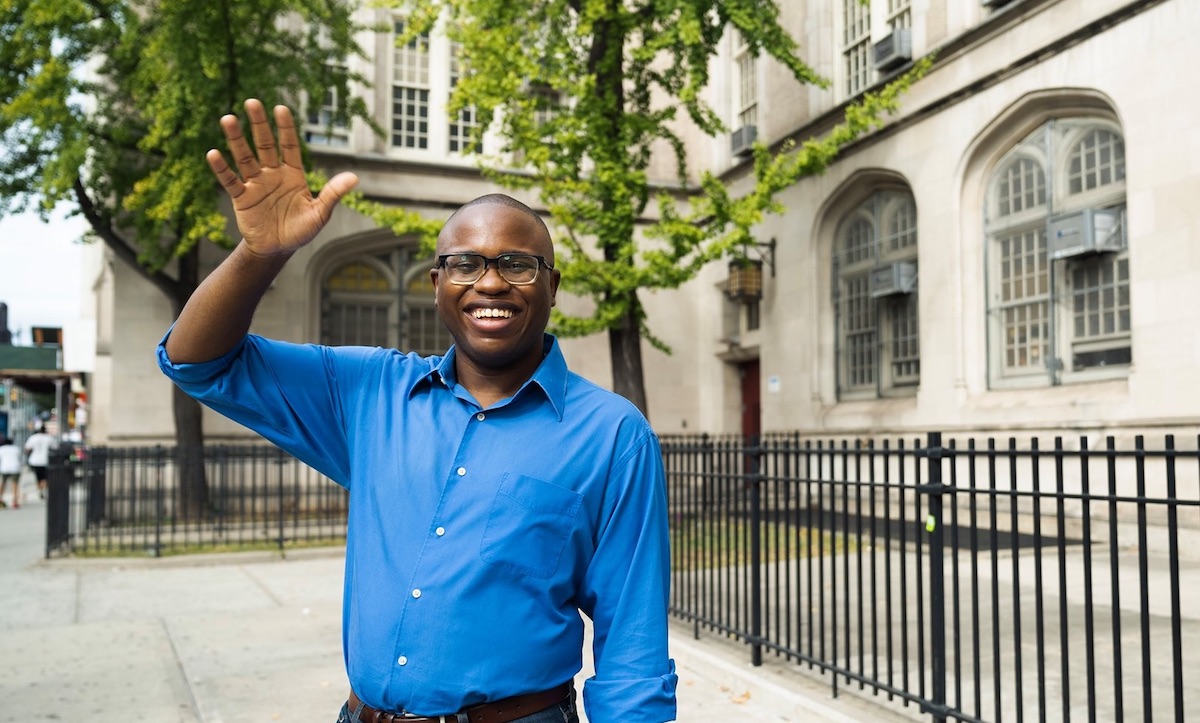
My wife is being asked if she deserves her own home health care. Under the Trump Administration's proposed rule on "medical frailty," millions more people in the U.S. will soon face the same question.
She lives with sickle cell disease, a serious, chronic illness that attacks the blood, causes episodes of excruciating pain, affects organ function, and limits physical endurance in ways that are often invisible. She has been hospitalized twice in the last year and three times the year before; one in a medically induced coma. She has a port installed in her chest, a small piece of plastic and metal that keeps her stable. She has mobility limitations and avascular necrosis that comes from the disease itself and from complications she experienced when our daughters were born. She is, by every honest definition of the word, disabled, and she has the medical record to prove it many times over.
Today, between the bureaucratic delays in approving her treatments and the new evaluations looking to determine whether she is "receiving too many unneeded services," she is being asked, in effect, to prove that her pain is legitimate and her disability serious enough to deserve the home care she is already getting. The fight is not over whether her care will be denied tomorrow. The fight is justifying — the constant, exhausting, dignity-eroding work of being interrogated by reviewers who have never met her about why she needs what she needs to get out of bed in the morning.
That is what austerity looks like at the kitchen table. It does not announce itself. It arrives as a letter. It arrives as a delayed appointment. It arrives as a phone call from a reviewer asking why a woman with sickle cell disease and a chest port needs help bathing. And it arrives, in this case, before the wave we know is coming has actually hit shore.
I am writing this as a husband who has watched all of that play out in our home. I am also writing as a community organizer with the New York City DSA Healthcare Working Group, alongside colleagues from Physicians for a National Health Program, in a moment when this city and this state are making decisions that will determine whether what is happening to my family will happen to hundreds of thousands of New York families this summer. The Trump budget cuts to Medicaid and the new punitive bureaucratic burdens being added on to those clinging to their benefits for dear life will make this experience a familiar one to millions nationwide.
On July 1, 2026, roughly 470,000 New Yorkers are scheduled to lose their no-cost coverage through the Essential Plan, the state program built specifically for working people who earn too much to qualify for Medicaid and too little to afford an unsubsidized marketplace plan. About 230,000 of them live in New York City. The cause is H.R. 1, Trump's 2025 budget bill, which stripped premium tax credits from green-card holders under five years, asylum recipients, parolees, Temporary Protected Status (TPS) holders, Deferred Action for Childhood Arrivals (DACA) recipients, and others and gutted an estimated $7.5 billion in annual federal support for the Essential Plan in the process. On January 1, 2027, new federal Medicaid work-reporting requirements and more frequent recertification requirements take effect. The New York City Comptroller's office estimates that those changes alone will push roughly 725,000 NYC Medicaid enrollees off the program for a total of around 1 million people in this city alone on track to lose health coverage. Furthermore, under current rules, future cuts are baked in.
A serious affordability agenda in New York City is impossible without an answer to the loss of healthcare that people can pay for. Free buses do not help a family whose breadwinner is one ER visit from medical bankruptcy. A rent freeze does not help a mother whose home-health hours have just been cut. Universal childcare does not help a father whose wife has lost the coverage that pays for the treatments or medications keeping her stable. Healthcare is the missing plank of the affordability agenda; unless it is added, the rest of that agenda will buckle.
Mayor Mamdani has already delivered some real wins. His $124.7 billion executive budget closed a $5.4 billion two-year gap without touching the city's reserves and without raising property taxes. With a major boost from DSA's organized "Tax the Rich" agitation, he pushed through a new pied-à-terre tax on second homes worth over $5 million, a reduction in a city tax credit for unincorporated business owners, $1.5 billion in agency savings, and a state-approved delay of pension payments that trimmed $1.6 billion from immediate outlays.
Zohran also won back sales-tax money the state had been intercepting in a delicate alliance with a governor who is not a natural ally. He delivered new universal childcare funding and the largest capital injection for public housing this city has seen in recent memory. Even the fiscally conservative city comptroller approved.
But neither the city's budget nor Albany's $268 billion spending package includes a serious solution to the imminent healthcare cliff. The state Senate agreed only to kick the can down the road to a commission and a new plan sometime this summer.
But New York State has roughly $10 billion that it accumulated under a predecessor program to the Essential Plan that could be used to fill the gap. The money exists. That is not a fiscal failure — it is a political one.
Meanwhile, the healthcare delivery system in this city is already collapsing under the strain. Brooklyn Hospital Center, which serves a patient population that is roughly 80% Medicaid- and Medicare-funded, may have to file for bankruptcy; its CEO asked Governor Hochul for $160 million and received $15 million. Earlier this year, more than 400 nurses at that same hospital lost their own health insurance for 6 weeks while the institution struggled to stay open.
The Maimonides-NYC Health + Hospitals integration — a $2.2 billion state-supported lifeline to a major Brooklyn safety-net system — is currently sitting in Brooklyn Supreme Court awaiting judicial approval. Assemblymember Phara Souffrant Forrest, a DSA member and socialist in office, questioned why a vital resource in central Brooklyn is under siege while the state can fund things like a stadium for the Buffalo Bills football team.
The health coverage cliff, the budget gaps, the bureaucratic siege on families like mine all have the same root cause and the same fundamental answer. New York needs the New York Health Act: a state-level, single-payer program that would eliminate premiums, copays, and deductibles; replace the patchwork of vulnerable federal programs with one continuous system; and free this state from the recurring choreography of federal cuts and partial backfill. A 2025 report from the city comptroller projected $3 billion in annual savings for New York City on employee health coverage alone and far larger savings statewide from administrative simplification and consolidated purchasing power.
We need it. We needed it yesterday. Anything short of it is a stopgap — but in this moment, this stopgap is what stands between hundreds of thousands of New Yorkers and uninsured catastrophe.